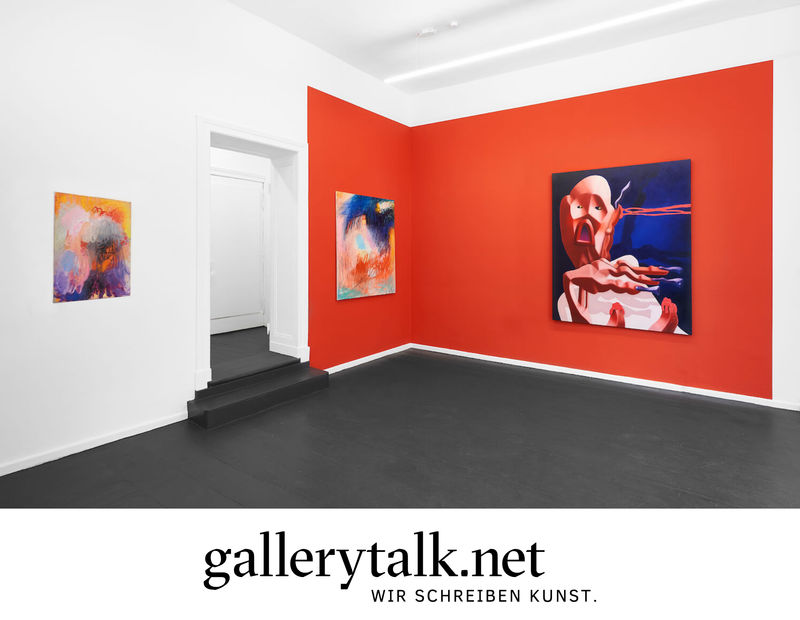
“The Future is Beautiful” — in times of crisis, instability, and a seemingly endless pandemic, this phrase appears under Berlin’s grey sky like a cynical comment on the present. After months of COVID-related closures of galleries, museums, and other exhibition spaces, however, the title of the exhibition featuring works by Cathrin Hoffmann and Anna Steinert can also be read as a declaration of defiance: a form of proof that something positive lies ahead, that waiting for art and culture is worthwhile. Upon entering the gallery spaces, one thing becomes immediately clear: the contrast between inside and outside could hardly be stronger. Where outside the grey of the rainy sky dominates, inside the power of colour radiates from the walls, confronting visitors and drawing them into the spell of the exhibited paintings. Following the hanging, the viewer alternates between the digitally distorted figures translated into painting in Cathrin Hoffmann’s work and the vivid, colourful abstractions of Anna Steinert.
The scale of the paintings ranges from large- to medium-format works across the three gallery rooms. The medium of painting itself, along with its colour and luminosity, allows the works of both artists to merge, image by image, into a harmonious whole within the spaces of Galerie Tanja Wagner. In the exhibition text, Tanja Wagner invites viewers to explore the question: what power does beauty hold in our world? A closer look reveals that both artists reflect on the power of beauty in markedly different ways. Cathrin Hoffmann’s work can be associated with Post-Digital Pop, a term coined by British artist Oli Epp to describe an art form that combines motifs of the internet and consumer culture while employing the formal language of Pop Art. On closer inspection, however, thematic and formal irregularities emerge beneath the smooth surface of Hoffmann’s work — blemishes on the skin of her figures or nipples rendered as coarse daubs of paint.
In the form of her digitally inflected beings, whose often sad and emotionally charged expressions bear deeply human traits, the Hamburg-based artist challenges classical notions of beauty and ideality. Hoffmann’s paintings, both formally and thematically, narrate a future that is beautiful in an unusual way. Coincidentally — yet no less poignantly — visitors, attending the gallery alone due to pandemic restrictions, find themselves reflected in the isolated, futuristic figures of Hoffmann’s paintings. This coincidence confronts viewers of this “beautiful future” with their own present.
Anna Steinert’s abstract paintings initially captivate through their bright and joyful palette. In her works, Steinert engages with a classical notion of beauty, playing with a sense of optimistic and soothing aesthetics, while formally breaking with traditional concepts of beauty in art through abstraction. Here, too, it is careful observation — a concentrated gaze — that allows forms and faces to emerge within the abstraction. In this way, Steinert ultimately locates beauty not merely on the surface, but beneath the layers of lines, wild loops, and colourful patches of oil paint, chalk, and acrylic, within a sense of immediacy.
In keeping with this impression, the Berlin-based artist situates beauty in her works within the imagination of the viewer. As Steinert states in the exhibition text: “In my paintings, it is not primarily seeing as a categorising faculty that determines what beauty is, but rather the inner eye, which also seeks an inner truth.” From viewers of her works, she thus appears to demand more than mere looking — a form of empathetic engagement. Beauty in the works of Cathrin Hoffmann and Anna Steinert is both strikingly direct and Instagrammable, as well as complex and multilayered. It exists on the surface of these works, within their formal means, as well as in deeper layers that reveal themselves only through attentive viewing and emotional immersion. It is this shared field of tension that allows the works of both artists to form a harmonious whole within a joint exhibition.
This, too, provides an answer to the question posed by the exhibition text regarding the power of beauty: in “The Future is Beautiful,” beauty becomes something that can be experienced. How fleeting this experience is — this powerfully colourful glimpse into the future — becomes apparent at the latest when stepping out of Galerie Tanja Wagner, as the grey and gloomy veil of the capital once again settles over the vivid colours. All the more reason, then, to briefly immerse oneself in a future that can indeed be beautiful — and that offers a welcome distraction from the grey routines of everyday life during the pandemic.
